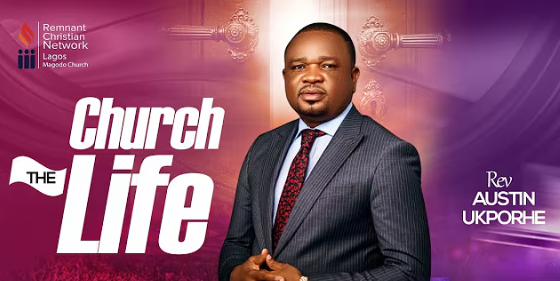
Matthew 16:13–19 gives us one of the most important pictures of the church. In this passage, Reverend Austin Ukporhe reminded us that church life isn’t a casual gathering. It is intentional, built on revelation, and sustained by power.
There are multitudes, and there are disciples. Miracles, excitement, and noise don’t make disciples. A true disciple is one who chooses Jesus, and by that same choice, allows Him to teach them daily by carrying the cross. Discipleship, therefore, happens at close range. You cannot know someone from afar and claim they are your mentor — you are simply a follower. Jesus chose His disciples, and they chose Him in return. That partnership of choice and intimacy became the ground for revelation.
When Jesus asked His disciples in Matthew 16:13, “Who do people say I am?” He wasn’t asking strangers. He was testing those who had walked with Him. Some said He was a prophet. But when Peter declared, “You are the Christ, the Son of the Living God,” Jesus affirmed that this wasn’t head knowledge. It was revelation from the Father. Revelation marks the foundation of the church.
The church is not an accident. It does not just appear — it must be built. Jesus said, “On this rock I will build my church.” Every church is an offshoot of human obedience. God does not bypass people to establish His work. The flow is heaven → man → the people. And if the man through whom God builds becomes compromised, that compromise will ripple across the body. This is why we must pray regularly for pastors and leaders — because the life of the church is tied to their faithfulness.
The church is personal (Peter as a person), corporate (the body of believers), and structural (the building and gathering). It is geographical, territorial, and eternal. And it carries an unshakable promise: the gates of hell will come, but they will not prevail. The enemy will launch attacks, but the church must stand guard. Hell does not get the final say.
For the church to march forward, power must flow within it. Without power, our words are empty; with power, our declarations become legislations that establish heaven’s will. Power drives out witchcraft and demonic authorities that seek to oppose God’s government.
The “gates of hell” represent authority. They oppose the church precisely because the church operates in the name of Jesus. But Jesus’ assurance is this: the church may face battering, but it will not be overcome. If life has battered you before, do not let it keep battering you inside the church. The life of the church must be marked by power, release, and victory.
The church is not just a New Testament phenomenon. It began in the wilderness with Israel — called out to belong to God. Jesus, the firstborn among many brethren, makes us part of this lineage. The same God who brought Israel through the wilderness is still building His church today.
This is the church life: intentional, consecrated, built on revelation, guarded by prayer, and sustained by the power of God.